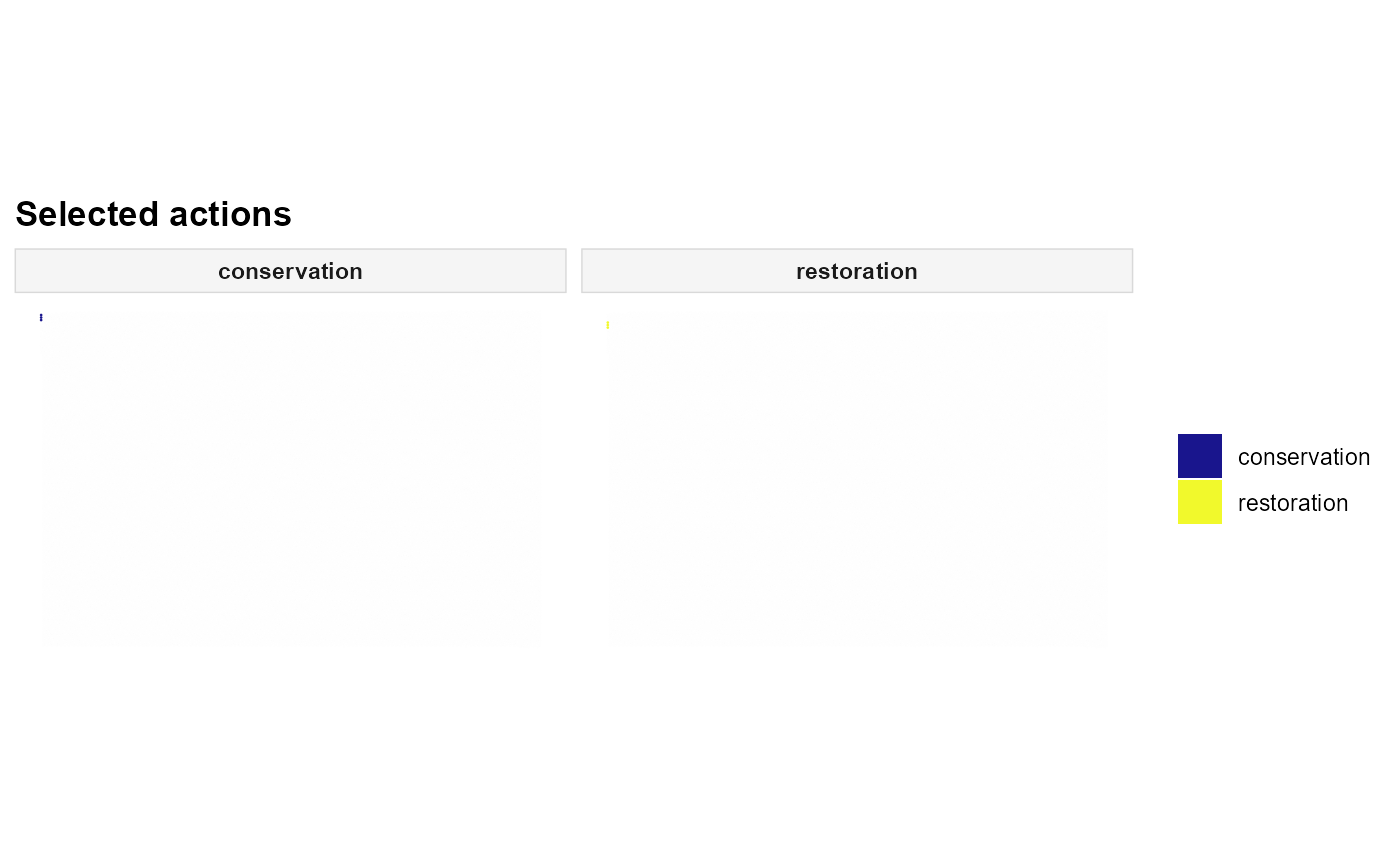
Plot the spatial distribution of selected actions from a
solutionset-class object returned by solve.
This function maps the selected planning unit–action pairs returned by
get_actions onto the planning-unit geometry stored in the associated
Problem object.
Usage
plot_spatial_actions(
  x,
  solutions = NULL,
  actions = NULL,
  layout = NULL,
  max_facets = 4L,
  nrow = NULL,
  ncol = NULL,
  ...,
  base_alpha = 0.08,
  selected_alpha = 0.95,
  base_fill = "grey95",
  base_color = NA,
  selected_color = NA,
  draw_borders = FALSE,
  show_base = TRUE,
  fill_values = NULL,
  fill_na = "grey80",
  use_viridis = TRUE
)
Arguments
- x
A
solutionset-classobject returned bysolve.- solutions
Optional integer vector of solution ids. If
NULL, the first available solution is plotted by default.- actions
Optional action subset to display. Entries may match action ids or action-set labels.
- layout
Character string controlling the layout. Must be one of
"single"or"facet". IfNULL, the default is"single".- max_facets
Maximum number of action facets shown when
actionsisNULLand faceting would otherwise create many panels.- nrow, ncol
Optional numbers of rows and columns used to arrange facets.
- ...
Reserved for future extensions.
- base_alpha
Numeric value in \([0,1]\) giving the alpha of the base planning-unit layer.
- selected_alpha
Numeric value in \([0,1]\) giving the alpha of the highlighted action layer.
- base_fill
Fill colour for the base planning-unit layer.
- base_color
Border colour for the base planning-unit layer.
- selected_color
Border colour for highlighted layers.
- draw_borders
Logical. If
FALSE, borders are not drawn.- show_base
Logical. If
TRUE, draw the base planning-unit layer underneath the highlighted output.- fill_values
Optional named vector of colours for discrete action maps.
- fill_na
Fill colour for missing values.
- use_viridis
Logical. If
TRUEand the viridis package is available, use viridis discrete scales.
Details
Let \(x_{ia} \in \{0,1\}\) denote whether action \(a\) is selected in
planning unit \(i\). This function plots the selected
(pu, action) pairs in geographic space.
If layout = "facet" and only one run is plotted, one panel is drawn
per action.
If layout = "single", all selected actions are drawn in a single map
using discrete fills. If more than one action is selected in the same
planning unit, the action labels are collapsed using "+".
When plotting multiple runs, only layout = "single" is supported.
Planning-unit geometry must be available in the associated problem object.
Examples
if (
  requireNamespace("sf", quietly = TRUE) &&
  requireNamespace("ggplot2", quietly = TRUE) &&
  requireNamespace("rcbc", quietly = TRUE)
) {
  # Load a complete simulated planning problem.
  example_data <- load_sim_multiaction()

  problem <- create_problem(
    pu = example_data$planning_units,
    features = example_data$features,
    dist_features = example_data$dist_features,
    cost = "cost"
  ) |>
    add_actions(
      example_data$actions,
      cost = example_data$action_costs
    ) |>
    add_effects(
      example_data$effect_assumptions
    ) |>
    add_constraint_targets_relative(0.05) |>
    add_objective_min_cost(alias = "cost", include_pu_cost = FALSE) |>
    add_objective_max_effect(alias = "benefit") |>
    set_method_weighted_sum(
      aliases = c("cost", "benefit"),
      runs = set_runs_grid(n = 3),
      normalize_weights = TRUE
    ) |>
    set_solver_cbc(verbose = FALSE)

  solutions <- solve(problem)

  plot_spatial_actions(
    solutions,
    layout = "single"
  )
}