Define an objective that minimizes the total cost of the solution.
Depending on the function arguments, the objective may include planning-unit costs, action costs, or both. Action costs can optionally be restricted to a subset of actions.
Usage
add_objective_min_cost(
  x,
  include_pu_cost = TRUE,
  include_action_cost = TRUE,
  actions = NULL,
  alias = NULL
)
Arguments
- x
A
Problemobject.- include_pu_cost
Logical. If
TRUE, include planning-unit costs in the objective.- include_action_cost
Logical. If
TRUE, include action costs in the objective.- actions
Optional subset of actions to include in the action-cost component. Values may match
x$data$actions$idand, if present,x$data$actions$action_set. IfNULL, all feasible actions are included in the action-cost term.- alias
Optional identifier used to register this objective for multi-objective workflows.
Details
Use this function when the planning problem is framed primarily as a cost-minimization problem, with costs arising from planning-unit selection, action implementation, or both.
Let \(\mathcal{I}\) be the set of planning units and let \(\mathcal{D} \subseteq \mathcal{I} \times \mathcal{A}\) denote the set of feasible planning unit–action decisions.
Let:
\(w_i \in \{0,1\}\) denote whether planning unit \(i\) is selected,
\(x_{ia} \in \{0,1\}\) denote whether action \(a\) is selected in planning unit \(i\),
\(c_i^{PU} \ge 0\) denote the planning-unit cost of unit \(i\),
\(c_{ia}^{A} \ge 0\) denote the cost of selecting action \(a\) in planning unit \(i\).
The most general form of this objective is:
$$ \min \left( \sum_{i \in \mathcal{I}} c_i^{PU} w_i + \sum_{(i,a) \in \mathcal{D}^{\star}} c_{ia}^{A} x_{ia} \right), $$
where \(\mathcal{D}^{\star}\) denotes the subset of feasible decisions whose action contributes to the action-cost term.
If include_pu_cost = FALSE, the planning-unit cost term is omitted.
If include_action_cost = FALSE, the action-cost term is omitted.
If actions = NULL, all feasible actions contribute to the action-cost
term. If actions is supplied, only the selected subset contributes to
that term. Planning-unit costs are never subset by actions; they are
always global whenever include_pu_cost = TRUE.
Repeated calls
With alias = NULL, one explicit single objective can be defined per
problem; a second unaliased definition raises an error. With an alias,
objectives accumulate under distinct names; a repeated alias raises an error.
Aliased definitions preserve an explicitly configured single objective.
To compare alternatives, start from the problem before its objective was added.
References
Ball, I. R., Possingham, H. P., and Watts, M. E. (2009). Marxan and relatives: software for spatial conservation prioritisation. In Spatial Conservation Prioritization: Quantitative Methods and Computational Tools, pp. 185–195. doi:10.1093/oso/9780199547760.003.0014
Salgado-Rojas, J., Hermoso, V., and Álvarez-Miranda, E. (2025). prioriactions: multi-action management planning in R. Methods in Ecology and Evolution, 16, 1028–1039. doi:10.1111/2041-210X.14220
Examples
# EXAMPLE: Minimum-cost management with a woodland target
#
# Use the 64 planning-unit landscape. The hypothetical outcome of 1
# credits one unit of woodland for either action in each selected unit.
# A target of 12 therefore requires at least 12 interventions.
sim <- load_sim_multiaction()

p <- create_problem(
  pu = sim$planning_units,
  features = sim$features,
  dist_features = sim$dist_features,
  cost = "cost"
) |>
  add_actions(sim$actions, cost = sim$action_costs) |>
  add_effects(data.frame(
    action = c("protect", "restore"),
    feature = "woodland", outcome = 1
  )) |>
  add_constraint_targets_absolute(12, features = "woodland") |>
  add_objective_min_cost(include_pu_cost = FALSE, alias = "cost")

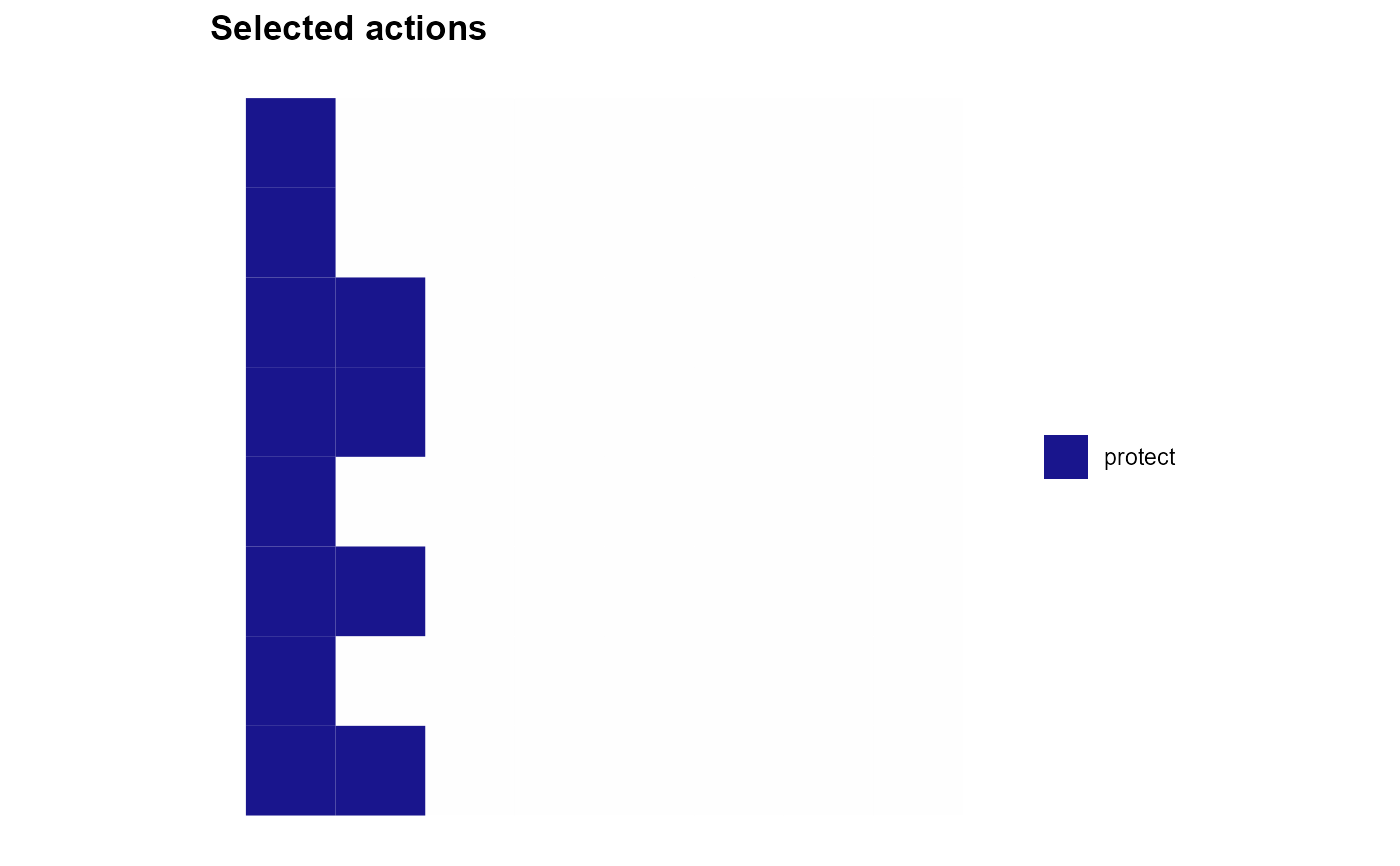
# The solver selects the least costly set of actions that meets the target.
# This is a single-objective model: no set_method_*() call is needed.
if (requireNamespace("rcbc", quietly = TRUE) &&
    requireNamespace("ggplot2", quietly = TRUE)) {
  solutions <- solve(set_solver_cbc(p, time_limit = 30, verbose = FALSE))
  get_objectives(solutions, format = "wide")
  plot_spatial_actions(solutions, layout = "single")
}