
Configure the epsilon-constraint multi-objective method
Source:R/set_method_epsilon_constraint.R
set_method_epsilon_constraint.RdOptimise one registered objective while imposing performance thresholds on the others. By varying these thresholds, the epsilon-constraint method produces alternative spatial plans along an observed trade-off frontier.
Usage
set_method_epsilon_constraint(
  x,
  primary,
  aliases = NULL,
  runs = NULL,
  eps = NULL,
  mode = NULL,
  n_points = NULL,
  include_extremes = NULL,
  lexicographic = TRUE,
  lexicographic_tol = 1e-08,
  control = NULL
)
Arguments
- x
A
Problemwith at least two registered objective aliases.- primary
Character scalar naming the objective to optimise directly.
- aliases
Optional character vector of registered objective aliases. By default, all registered objectives are used;
primarymust be included.- runs
A run design from
set_runs_grid()orset_runs_manual(). Automatic grids require exactly two objectives. Manual designs requireeps_<alias>columns for all constrained objectives.- eps, mode, n_points, include_extremes
Deprecated arguments from the previous interface. Use
runsinstead.include_extremesis ignored; automatic grids always include their endpoints.- lexicographic
Logical. Whether to refine automatic-grid anchor solutions lexicographically; the default is
TRUE.- lexicographic_tol
Non-negative tolerance for lexicographic anchor refinement, expressed in the first objective's original units.
- control
Optional run-failure settings from
set_runs_control().
Value
An updated Problem with the method stored in x$data$method.
Run-specific epsilon bounds are constructed or read during solve().
Details
First, register at least two objectives with distinct alias values.
primary identifies the objective to optimise directly; every other alias
included in aliases becomes an epsilon-constrained objective. For example,
maximising woodland improvement while restricting expenditure gives
$$\max f_{\mathrm{woodland}}(x)$$
subject to
$$f_{\mathrm{cost}}(x) \le \varepsilon.$$
For a constrained maximisation objective, the corresponding requirement is
a lower bound, \(f_k(x) \ge \varepsilon_k\). Epsilon values are objective
values in their original units, not weights or relative preferences.
Automatic grids. runs = set_runs_grid(n = 5) generates five epsilon
levels, including the two endpoints, from objective extreme-point or payoff
information computed during solve(). Automatic grids currently support
exactly two objectives: one primary and one constrained objective.
With lexicographic = TRUE, the anchor solutions are refined using the
other objective to break near-ties. lexicographic_tol controls the allowed
deterioration of the first objective during that refinement; it is expressed
in that objective's units. This option concerns automatic-grid anchors, not
every subsequent epsilon-constrained run.
Automatic warm starts. Successful solutions are reused as initial candidates for subsequent anchor stages and epsilon runs when supported by the solver (CBC and Gurobi). Automatic grids proceed from the most restrictive secondary bound to the most permissive; manual designs keep their supplied order. A run without a usable solution retains the last successful candidate. This behaviour is internal and requires no additional argument.
Manual thresholds. Use runs = set_runs_manual() to supply explicit
bounds. Each row defines one run, with a column named eps_<alias> for
every constrained objective. For example, eps_cost = 10 means cost at
most 10, even if the optimal plan spends less. Manual designs support
two or more objectives; they do not automatically expand combinations
of epsilon levels. Use expand.grid() to create such a design explicitly.
Interpreting results. The method does not guarantee a different plan
for each epsilon level, nor does a finite grid enumerate the full Pareto
frontier. A basic epsilon-constraint formulation can also produce weakly
efficient solutions when an unconstrained secondary objective could improve
without worsening the primary objective. For augmented tie-breaking, see
set_method_augmecon(). Some requested thresholds may be infeasible; use
set_runs_control() to specify how unsuccessful runs are handled. The
returned solution diagnostics include checks of the epsilon bounds.
Only one multi-objective method can be configured on a Problem. To compare
methods or threshold designs, start again from the problem before its
method was configured. The older eps, mode, n_points, and
include_extremes arguments are deprecated; use runs instead.
References
Haimes, Y. Y., Lasdon, L. S., and Wismer, D. A. (1971). On a bicriterion formulation of the problems of integrated system identification and system optimization. IEEE Transactions on Systems, Man, and Cybernetics, SMC-1(3), 296-297. doi:10.1109/TSMC.1971.4308298 .
Mavrotas, G. (2009). Effective implementation of the epsilon-constraint method in multi-objective mathematical programming problems. Applied Mathematics and Computation, 213(2), 455-465. doi:10.1016/j.amc.2009.03.037 .
Examples
# EXAMPLE: Maximise woodland improvement under alternative cost limits.
# The landscape has 64 planning units and two candidate actions per unit.
sim <- load_sim_multiaction()
base <- create_problem(
pu = sim$planning_units,
features = sim$features,
dist_features = sim$dist_features,
cost = "cost"
) |>
add_actions(sim$actions, cost = sim$action_costs) |>
add_effects(sim$effect_assumptions) |>
# Require some woodland improvement, so the low-cost plan is not empty.
add_constraint_targets_relative(0.05, features = "woodland") |>
add_objective_max_effect(
features = "woodland", alias = "woodland"
) |>
add_objective_min_cost(
include_pu_cost = FALSE, alias = "cost"
)
# Generate five cost limits automatically from the objective extremes.
epsilon <- set_method_epsilon_constraint(
base,
primary = "woodland",
aliases = c("woodland", "cost"),
runs = set_runs_grid(n = 5),
lexicographic = TRUE
)
if (requireNamespace("rcbc", quietly = TRUE) &&
requireNamespace("ggplot2", quietly = TRUE)) {
solutions <- solve(
set_solver_cbc(epsilon, time_limit = 30, verbose = FALSE)
)
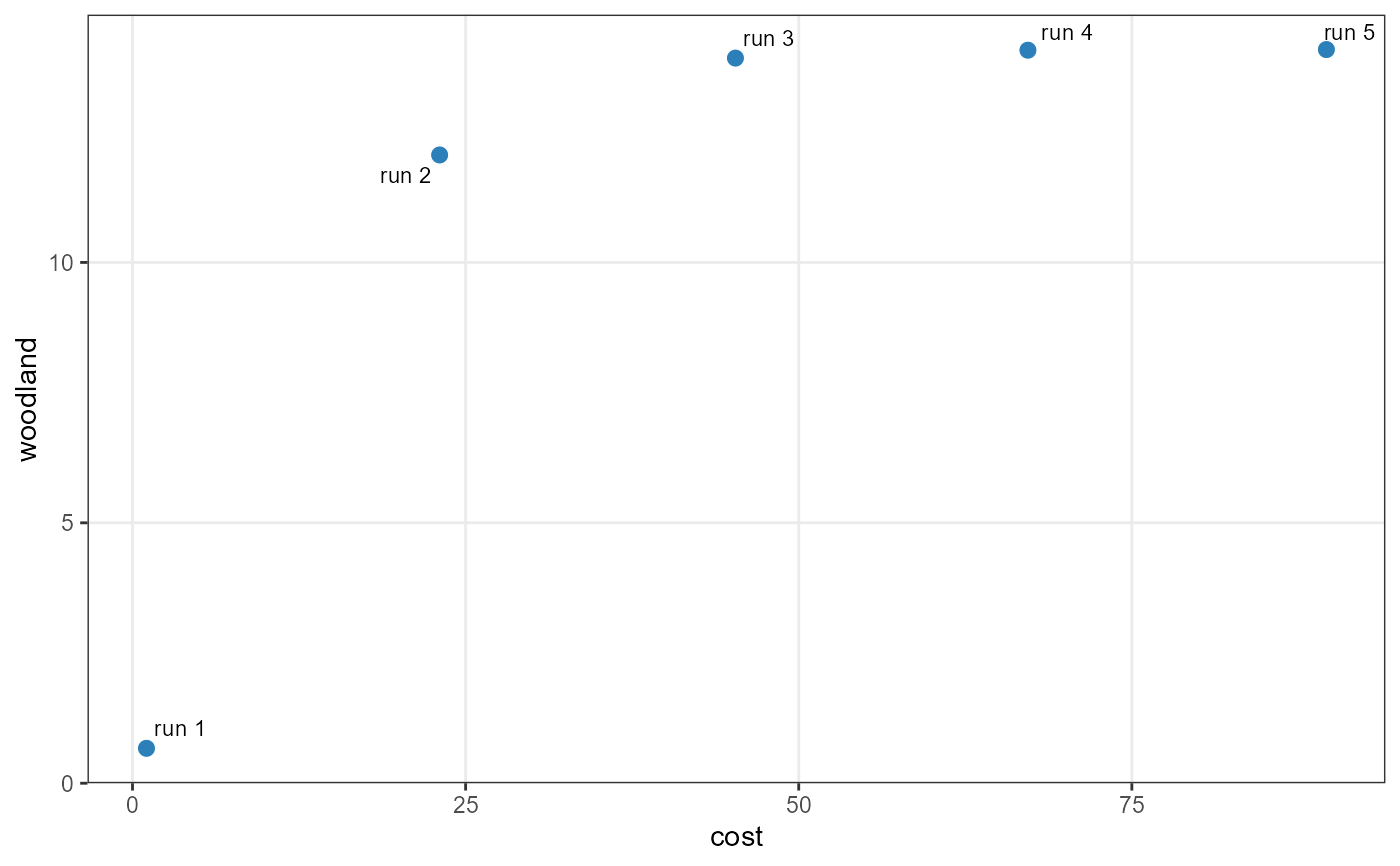
# Each run maximises woodland gain subject to its own cost ceiling.
get_objectives(solutions, format = "wide")
# The horizontal axis shows actual cost, not the epsilon ceiling.
plot_tradeoff(
solutions, objectives = c("cost", "woodland"),
label_runs = TRUE
)
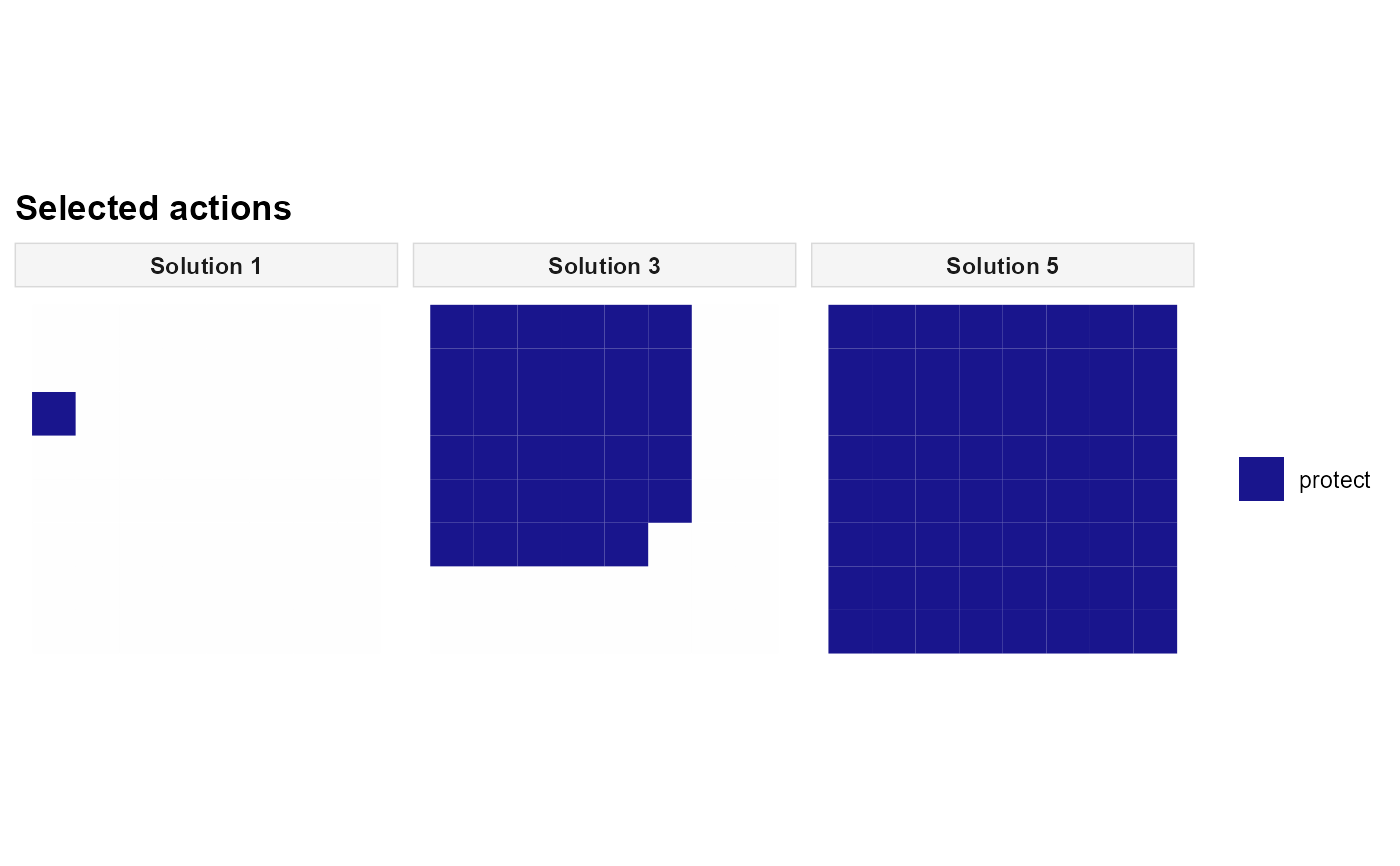
# Compare low-, intermediate- and high-cost spatial prescriptions.
# Epsilon levels can sometimes produce the same selected actions.
plot_spatial_actions(
solutions, solutions = c(1, 3, 5), layout = "single", ncol = 3
)
}
 # ALTERNATIVE: specify explicit cost ceilings rather than a grid.
# Start from 'base', since each Problem can have only one method.
manual <- set_method_epsilon_constraint(
base,
primary = "woodland",
aliases = c("woodland", "cost"),
runs = set_runs_manual(data.frame(eps_cost = c(10, 20, 40)))
)
# ALTERNATIVE: specify explicit cost ceilings rather than a grid.
# Start from 'base', since each Problem can have only one method.
manual <- set_method_epsilon_constraint(
base,
primary = "woodland",
aliases = c("woodland", "cost"),
runs = set_runs_manual(data.frame(eps_cost = c(10, 20, 40)))
)