Maximize the total signed change generated by selected management actions relative to the reference scenario. Positive changes increase the objective; negative changes reduce it.
Arguments
- x
A
Problemobject.- actions
Optional subset of actions to include in the objective. Values may match
x$data$actions$idand, if present,x$data$actions$action_set. IfNULL, all actions are included.- features
Optional subset of features to include in the objective. Values may match
x$data$features$idand, if present,x$data$features$name. IfNULL, all features are included.- alias
Optional identifier used to register this objective for multi-objective workflows.
Details
Let \(\Delta_{if}(x)\) be the signed change for planning unit \(i\) and feature \(f\), after combining selected individual actions and their interaction corrections. The objective is $$\max \sum_{i,f} \Delta_{if}(x).$$ For one action per unit this reduces to the sum of selected signed effects. With concurrent actions, supplied joint totals and inferred combinations are evaluated together; a negative interaction correction is not discarded.
The reference is the scenario supplied through dist_features, at the
same horizon and in the same units as action outcomes. An unselected unit
contributes zero change. Costs are not subtracted by this objective.
A positive effect means an increase in the feature; select features for which
an increase is desirable. Standardize incompatible units before aggregation,
or register separate feature objectives using distinct aliases.
With actions, include only individual terms in that subset and joint
corrections whose every member belongs to it. This is an accounting scope,
not attribution of a cross-subset interaction to its individual members.
With features, include only the selected features.
Changed behavior
This development version maximizes signed net change. Earlier versions
maximized positive effects only. Models with negative effects or negative
interaction corrections may therefore produce different solutions. The
historical add_objective_max_benefit() name is deprecated in favor of
add_objective_max_effect(). get_features() still reports positive gains separately in
selected_benefit; the signed objective corresponds to
selected_net when their scopes match.
Repeated calls
With alias = NULL, one explicit single objective can be defined per
problem; a second unaliased definition raises an error. With an alias,
objectives accumulate under distinct names; a repeated alias raises an error.
Aliased definitions preserve an explicitly configured single objective.
To compare alternatives, start from the problem before its objective was added.
References
Tallis, H., et al. (2021). Prioritizing actions: spatial action maps for conservation. Annals of the New York Academy of Sciences, 1505, 118–141. doi:10.1111/nyas.14651
Salgado-Rojas, J., Álvarez-Miranda, E., Hermoso, V., Garcia-Gonzalo, J., and Weintraub, A. (2020). A mixed integer programming approach for multi-action planning for threat management. Ecological Modelling, 418, 108901. doi:10.1016/j.ecolmodel.2019.108901
Examples
# EXAMPLE: Maximise woodland gain in a fixed number of units
#
# The bundled landscape has spatially varying woodland reference
# amounts. Assume restoration increases these amounts by 50%.
# The absolute signed effect is therefore larger where the
# reference amount is greater.
sim <- load_sim_multiaction()

p <- create_problem(
  pu = sim$planning_units,
  features = sim$features,
  dist_features = sim$dist_features,
  cost = "cost"
) |>
  add_actions(data.frame(id = "restore"), cost = 1) |>
  add_effects(data.frame(
    action = "restore", feature = "woodland", relative_change = 0.50
  )) |>
  add_constraint_budget(12, "equal", include_pu_cost = FALSE) |>
  add_objective_max_effect(features = "woodland", alias = "woodland_gain")

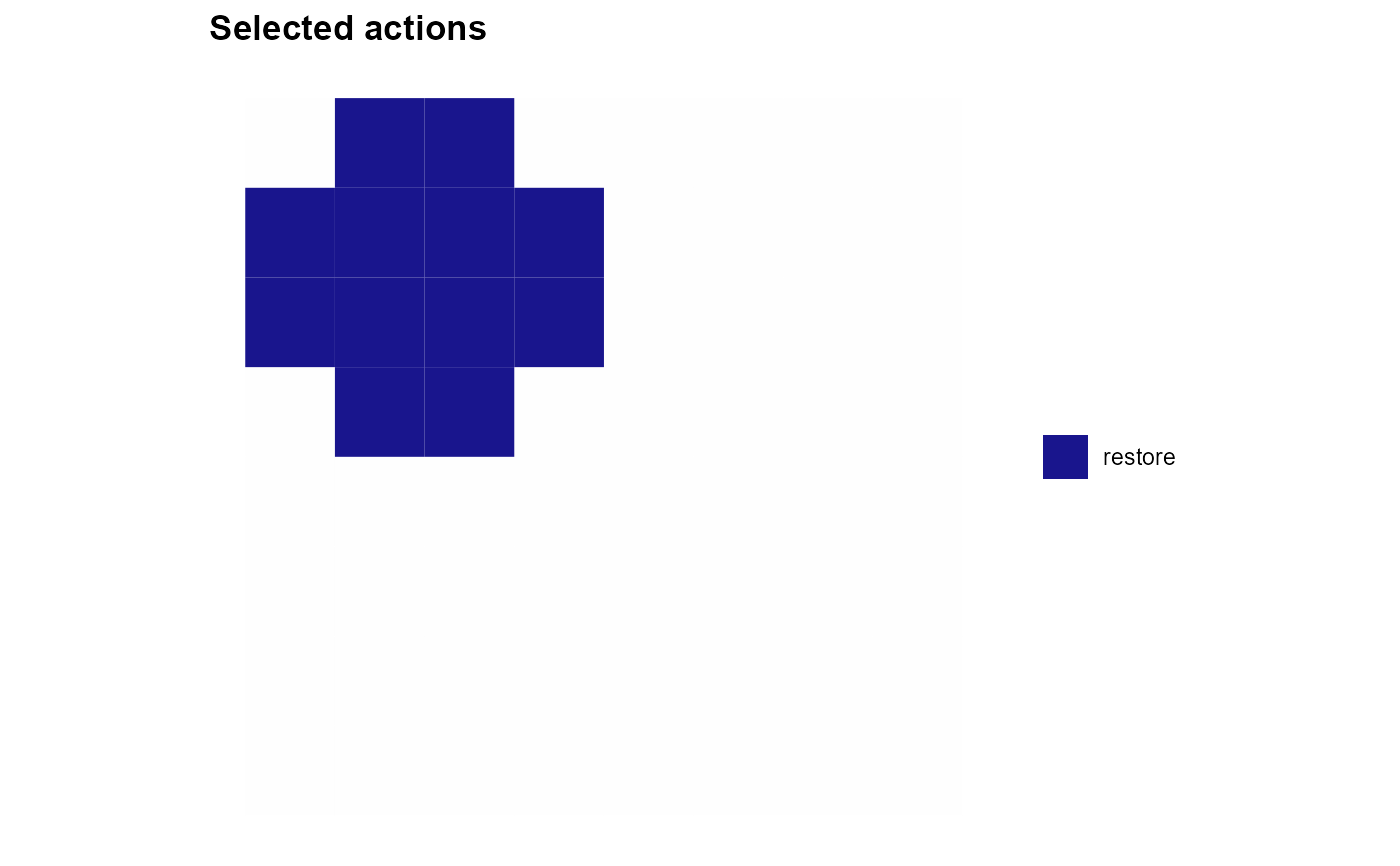
# Every restoration costs one monetary unit, so exactly 12 units
# must be managed. The objective favours the largest woodland gains.
if (requireNamespace("rcbc", quietly = TRUE) &&
    requireNamespace("ggplot2", quietly = TRUE)) {
  solutions <- solve(set_solver_cbc(p, time_limit = 30, verbose = FALSE))
  get_objectives(solutions, format = "wide")
  plot_spatial_actions(solutions, layout = "single")
}