Require companion actions in each planning unit
Source:R/add_constraint_action_relations.R
add_constraint_action_requires.RdMake the selection of one or more actions conditional on selecting
companion actions in the same planning unit. With sense = "all", every
companion is required; with sense = "any", at least one is required.
Usage
add_constraint_action_requires(
  x,
  actions,
  requires,
  sense = c("all", "any"),
  pu = NULL,
  name = NULL
)
Arguments
- x
A
Problemwith actions registered byadd_actions().- actions
Non-empty vector of triggering action IDs or existing
actions$action_setclassification labels. For excludes and together, this is the group of related actions and must resolve to at least two distinct actions. Identifiers registered throughadd_action_sets()are not selectable actions; supply their individual members.- requires
Non-empty vector of companion action IDs or existing classification labels, disjoint from
actions.- sense
"all"(default) requires every companion;"any"requires at least one companion.- pu
Optional external planning-unit IDs.
NULLapplies the rule to all planning units.- name
Optional unique, non-empty constraint label. If omitted, a label is generated automatically.
Value
A new Problem with the relation appended to
x$data$constraints$action_relations. The input problem is unchanged.
Details
How the relation works
Suppose restoration is effective only when threat control is also carried out. If restoration is selected, control must also be selected; if restoration is not selected, the relation imposes no requirement. With several triggering actions, each independently activates the requirement.
For binary action decisions \(x_{ia}\), requiring all companions gives
\(x_{ia} \le x_{ib}\) for each required action \(b\). Requiring any
companion gives \(x_{ia} \le \sum_b x_{ib}\). When there is only one
companion, "all" and "any" are equivalent.
Scope and feasibility
Each relation applies separately within each unit specified by pu;
pu = NULL applies it to all registered planning units. Relations do not
select actions by themselves or make unavailable actions feasible.
By default, at most one action can be selected per planning unit.
Use add_constraint_action_cardinality() when a requires or together rule
needs simultaneous selections. Unavailable or locked-out actions are treated
as unselected: missing companions may prohibit a trigger, and a missing
together member may prohibit the other members. Combined rules, budgets,
and locks can also make a model infeasible.
Relations do not imply a temporal sequence or dependencies between different
planning units. They can be combined with joint effects registered through
add_action_sets(), but defining a joint effect does not itself require
actions to be selected together.
Repeated calls
Distinct rules accumulate and are enforced simultaneously. Duplicate rules with the same type, action groups, sense, and PU scope are rejected; names must be unique across requires, excludes, and together relations. To revise a rule, start from the problem before that rule was added.
Examples
# EXAMPLE 1: Create a problem where concurrent actions are possible

# Three planning units offer restoration, control, fencing, and monitoring.
# Allow up to three actions per unit: the default one-action maximum
# would otherwise prevent restoration and its companions being selected.

base <- create_problem(
  pu = data.frame(id = c(10L, 20L, 30L), cost = 0),
  features = data.frame(id = 1L, name = "habitat"),
  dist_features = data.frame(
    pu = c(10L, 20L, 30L), feature = 1L, amount = 100
  )
) |>
  add_actions(
    data.frame(id = c("restore", "control", "fence", "monitor")),
    cost = 1
  ) |>
  add_constraint_action_cardinality(3, "max")

# EXAMPLE 2: Require all companions in a specific unit

# In unit 10, restoration must be accompanied by both control and fencing.
# This is a conditional requirement: it does not force restoration.

required <- add_constraint_action_requires(
  base,
  actions = "restore",
  requires = c("control", "fence"),
  sense = "all",
  pu = 10L,
  name = "restore_with_both"
)

# EXAMPLE 3: Require at least one alternative companion

# In unit 20, either control OR fencing is sufficient for restoration.
# These rules have different PU scopes and can coexist.

required <- add_constraint_action_requires(
  required,
  actions = "restore",
  requires = c("control", "fence"),
  sense = "any",
  pu = 20L,
  name = "restore_with_either"
)

# EXAMPLE 4: Multiple independent triggers

# In unit 30, choosing either restoration or monitoring requires control.
# The triggers need not both be selected.

required <- add_constraint_action_requires(
  required,
  actions = c("restore", "monitor"),
  requires = "control",
  pu = 30L
)

# Inspect the three registered rules (not an optimised solution).
required$data$constraints$action_relations[, c("type", "sense", "name")]
#>       type sense                name
#> 1 requires   all   restore_with_both
#> 2 requires   any restore_with_either
#> 3 requires   all   action_requires_3

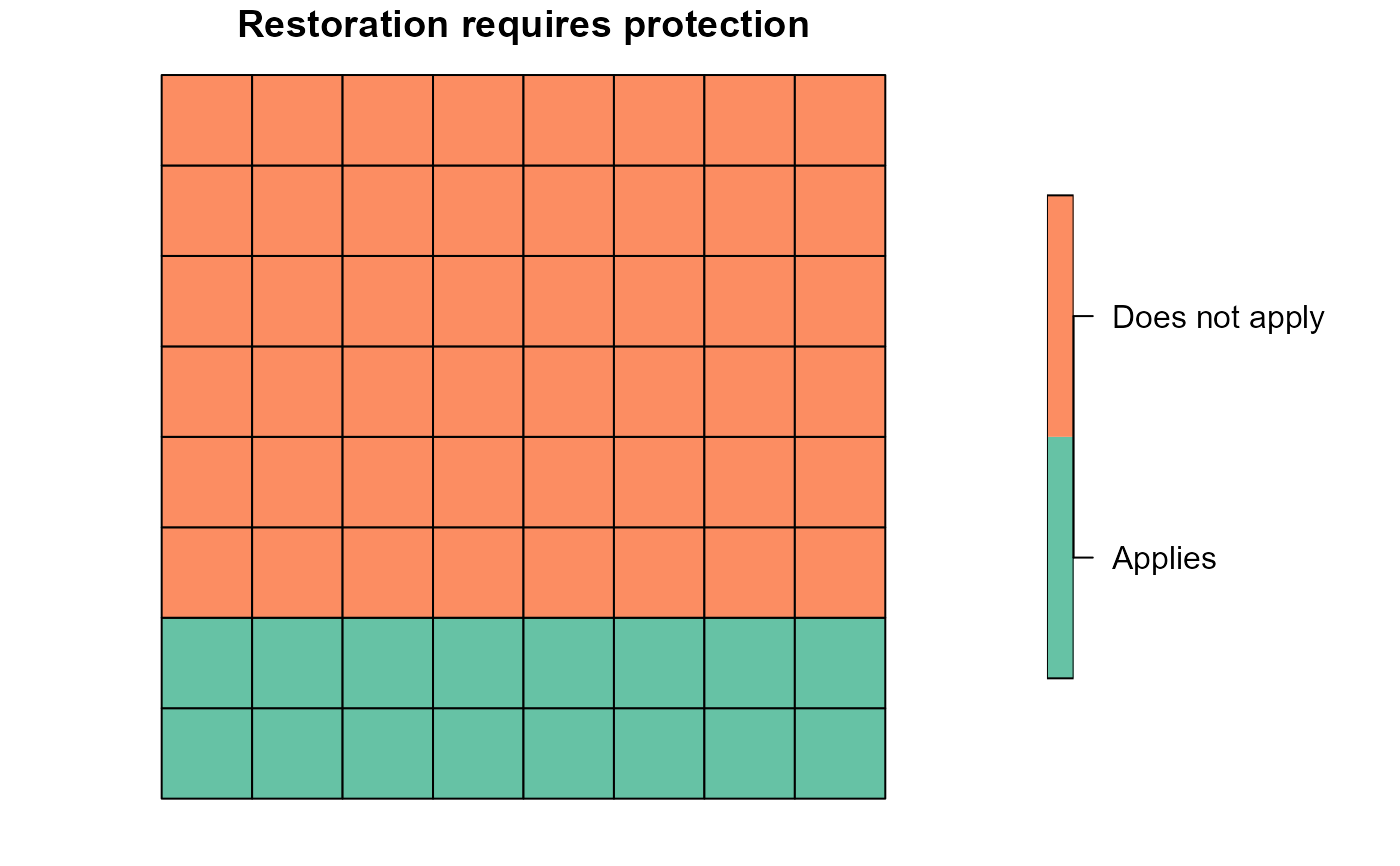
# EXAMPLE 5: Map where a requirement applies (no solver needed)

if (requireNamespace("sf", quietly = TRUE)) {
  sim <- load_sim_multiaction()

  # Apply the restoration-protection requirement to the first 16 cells.
  # Both actions may be selected in these cells, so permit cardinality 2.
  scoped_pu <- head(sim$planning_units$id, 16)
  spatial <- create_problem(
    pu = sim$planning_units,
    features = sim$features,
    dist_features = sim$dist_features,
    cost = "cost"
  ) |>
    add_actions(sim$actions, cost = sim$action_costs) |>
    add_constraint_action_cardinality(2, "max", pu = scoped_pu) |>
    add_constraint_action_requires(
      "restore", "protect", pu = scoped_pu
    )

  # The map shows the SCOPE of the requirement, not selected actions.
  mapped <- sim$planning_units
  mapped$requirement <- ifelse(
    mapped$id %in% scoped_pu, "Applies", "Does not apply"
  )
  plot(mapped["requirement"], main = "Restoration requires protection")
}