Add objective: minimise action fragmentation
Source:R/add_objectives.R
add_objective_min_fragmentation_action.RdEncourage spatial cohesion separately for each selected action, rather than only for the union of managed planning units.
Usage
add_objective_min_fragmentation_action(
  x,
  relation_name = "boundary",
  weight_multiplier = 1,
  action_weights = NULL,
  actions = NULL,
  alias = NULL
)
Arguments
- x
A
Problemobject.- relation_name
Character string giving the name of the spatial relation to use. The relation must already exist in
x$data$spatial_relations.- weight_multiplier
Numeric scalar greater than or equal to zero. Global multiplier applied to the relation weights when the objective is built.
- action_weights
Optional action weights. Either a named numeric vector with names equal to action ids, or a
data.framewith columnsactionandweight. These weights scale the contribution of each action to the final objective.- actions
Optional subset of actions to include. Values may match
x$data$actions$idand, if present,x$data$actions$action_set. IfNULL, all actions are included.- alias
Optional identifier used to register this objective for multi-objective workflows.
Details
This objective uses the action-selection decisions \(x_{ia}\) and a previously registered spatial relation. For neighbouring units \(i\) and \(j\), \(b_{ija}=x_{ia} \land x_{ja}\) represents whether the same action \(a\) occurs in both units. Adjacency of different actions does not form a continuous patch of either action.
For each action, the relation is restricted automatically to its feasible
planning-unit/action pairs (as supplied through include_pairs and
retained in the compiled model). An off-diagonal link contributes only if
that action is feasible at both endpoints. A feasible but unselected action
remains in this domain. No extra argument or correction objective is needed.
Self-boundary weights contribute only where that action is feasible.
Use actions to select which action patterns contribute,
action_weights to adjust their relative importance, and
weight_multiplier to scale spatial relation weights.
Unlike add_objective_min_fragmentation_planning_units(),
this objective distinguishes action identities. Combine it with
coverage or allocation requirements so an empty plan is not optimal.
Repeated calls
With alias = NULL, one explicit single objective can be defined per
problem; a second unaliased definition raises an error. With an alias,
objectives accumulate under distinct names; a repeated alias raises an error.
Aliased definitions preserve an explicitly configured single objective.
To compare alternatives, start from the problem before its objective was added.
References
Salgado-Rojas, J., Álvarez-Miranda, E., Hermoso, V., Garcia-Gonzalo, J., and Weintraub, A. (2020). A mixed integer programming approach for multi-action planning for threat management. Ecological Modelling, 418, 108901. doi:10.1016/j.ecolmodel.2019.108901
Álvarez-Miranda, E., Salgado-Rojas, J., Hermoso, V., Garcia-Gonzalo, J., and Weintraub, A. (2020). An integer programming method for the design of multi-criteria multi-action conservation plans. Omega, 92, 102147. doi:10.1016/j.omega.2019.102147
Examples
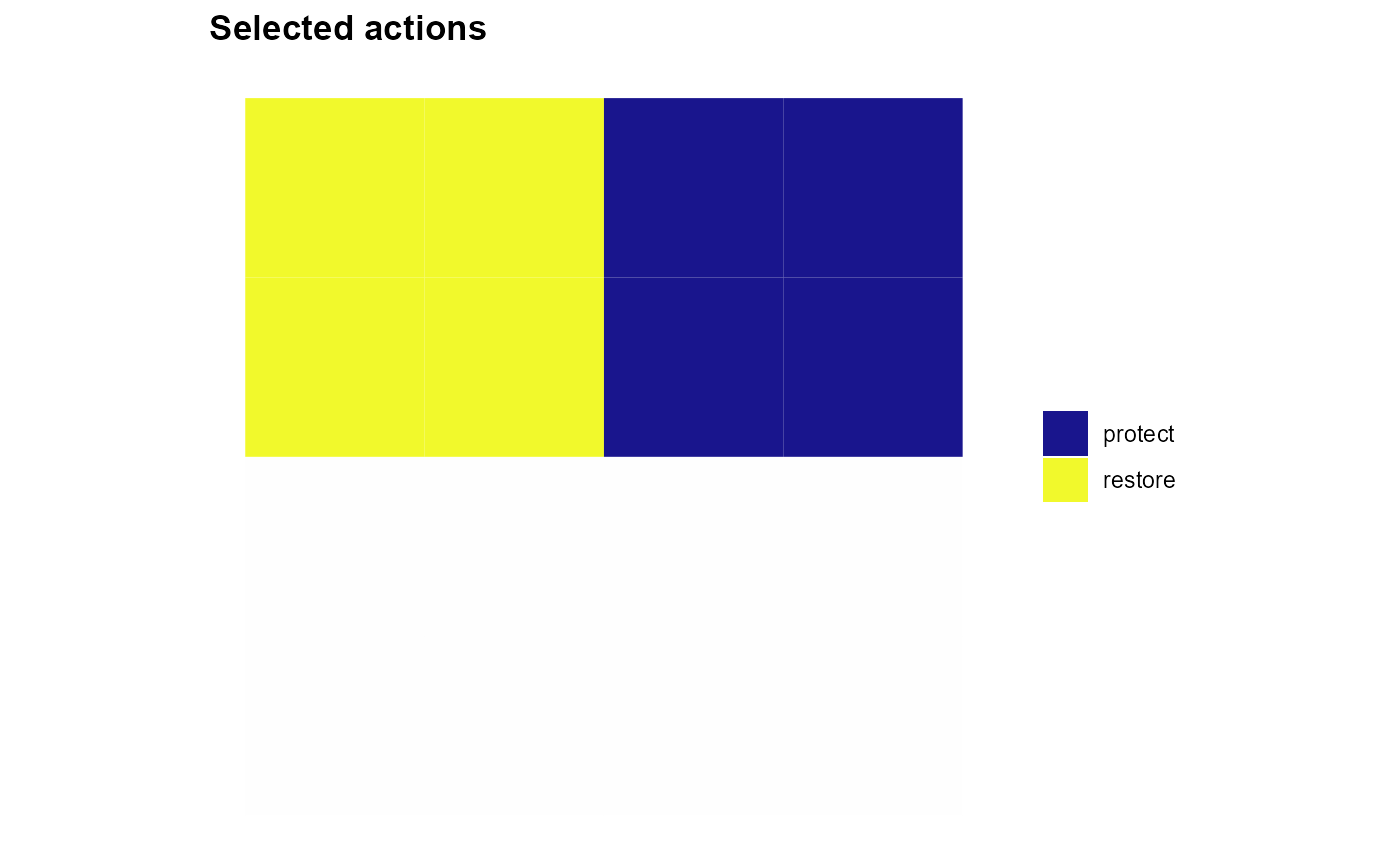
# EXAMPLE: Form separate cohesive patches for two actions
#
# Each action costs one unit. Two action-specific budget equalities
# require exactly four protection and four restoration units.
# The default one-action-per-unit rule prevents overlapping actions.
sim <- load_sim_multiaction()
# Use a 4 by 4 subset so this example solves quickly.
planning_units <- subset(sim$planning_units, x < 4 & y < 4)
dist_features <- subset(sim$dist_features, pu %in% planning_units$id)

p <- create_problem(
  pu = planning_units,
  features = sim$features,
  dist_features = dist_features,
  cost = "cost"
) |>
  add_actions(sim$actions, cost = 1) |>
  add_spatial_boundary(name = "boundary", include_self = TRUE) |>
  add_constraint_budget(
    4, "equal", actions = "protect", include_pu_cost = FALSE
  ) |>
  add_constraint_budget(
    4, "equal", actions = "restore", include_pu_cost = FALSE
  ) |>
  add_objective_min_fragmentation_action(relation_name = "boundary", alias = "action_fragmentation")

# Unlike planning-unit fragmentation, this objective measures
# the cohesion of each action's selected units separately.
if (requireNamespace("rcbc", quietly = TRUE) &&
    requireNamespace("ggplot2", quietly = TRUE)) {
  solutions <- solve(set_solver_cbc(p, gap_limit = 0, time_limit = 5, verbose = FALSE))
  get_objectives(solutions, format = "wide")
  plot_spatial_actions(solutions, layout = "single")
}